Phase One Activation
Somalia, Ethiopia, Eritrea — Food, Water & Cultural Defense Grid
Prepared by: Fifth House of Creativity Inc.
Sovereign Underwriter: Amethyst Amaris
Date of Issue: August 3, 2025
Instrument Class: Geopolitical + Cultural Repatriation + Ecological Repair
Trust Protections: Genius Trust™, IKWE Trusted™, The 11th House Disbursement Framework™
Abstract
The Horn of Africa Sovereign Restoration Instrument™ is a sovereign financial structure created to regenerate food, water, and cultural sovereignty across Somalia, Ethiopia, and Eritrea. Anchoring non-extractive restoration systems, it focuses on aquifer regeneration, Indigenous seed banks, maritime economy rebuilding, trauma healing sanctuaries, and oral language grids. This initiative positions survival assets as sovereign IP protected by trust, ensuring long-term resilience beyond aid dependency.
Assertions
This is not aid—it is repatriation. By embedding water, seeds, and languages into trust-backed frameworks, the Horn is shielded from privatization and exploitation, securing ecological and cultural survival across generations.
Mechanics
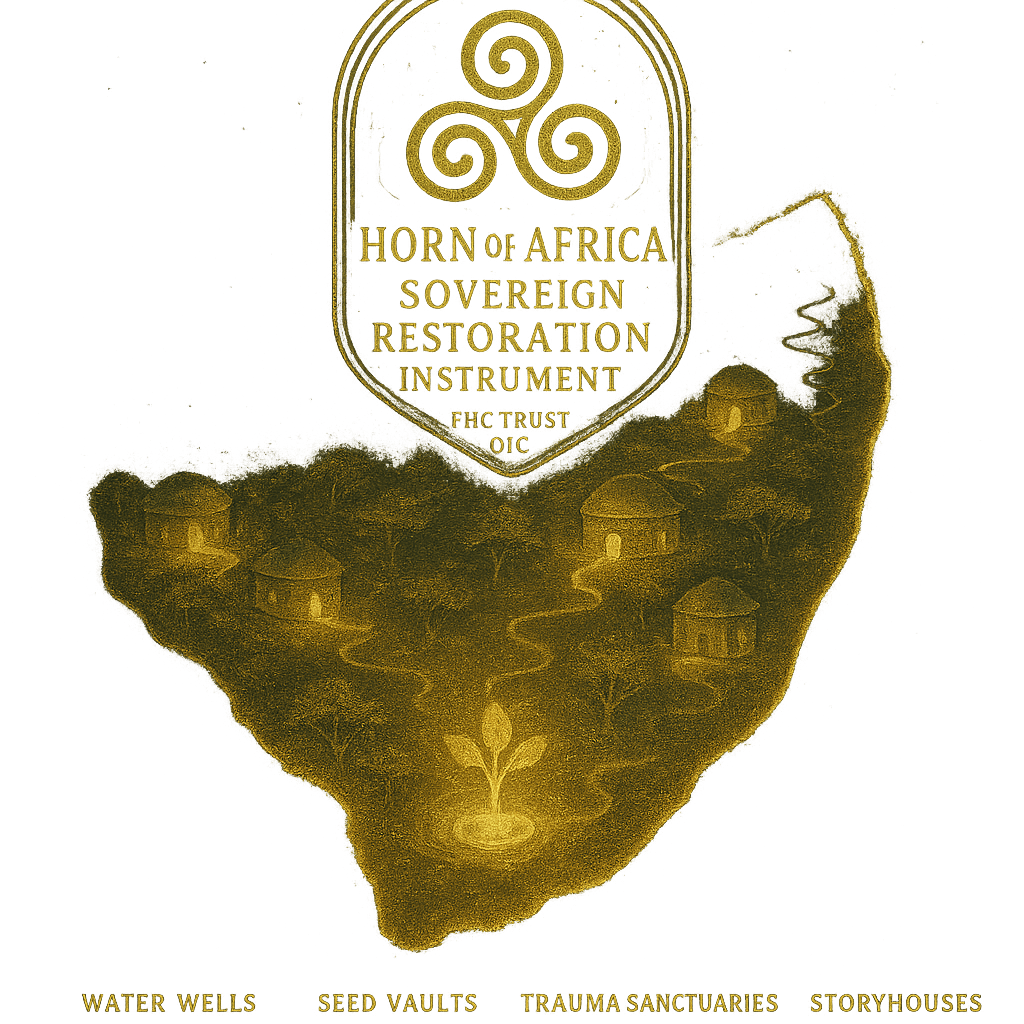
- Water Grid: aquifer recovery, AWGs, bioceramic filtration, youth Water Guardians.
- Seed Banks: clay-cooled vaults, women-led farming, encrypted genealogies.
- Maritime Regeneration Zones™: reef rebuilding, fisherwomen’s cooperatives, sovereign seaweed licensing.
- Child Soldier Rehabilitation: trauma sanctuaries, ceremonial name rebirth, stipends via dividend wallets.
- Oral Language Protection: biometrically secured voice archives, Root Right Protocols™, smoke dome recording houses.
Valuation
Phase One allocation valued in the multi-billion CAD range.
Overall instrument projected to scale into the hundreds of billions CAD depending on ecological and cultural yield.
Governance
- Structured under Genius Trust™, IKWE Trusted™, and The 11th House framework.
- Local councils: Elders & Daughters for seeds, Matriarchal water councils, oral historians, trauma recovery stewards.
- All mechanisms ledgered in Dreamlocked Trust System™.
Compliance
- Trust protections prevent privatization or extraction.
- Blockchain/biometric protocols secure seeds, languages, and cultural rites.
- CRA-compatible IP classification ensures transparency.
Risks & Mitigations
- Corporate/state extraction → mitigated by trust firewalls + ritual sovereignty protocols.
- Trauma relapse → mitigated through sanctuary-based non-carceral healing.
- Climate shocks → mitigated by biochar restoration, aquifer cycles, regenerative coastal farming.
Evidence
Filed August 3, 2025 under Fifth House of Creativity Inc.
Phase One pre-allocations confirmed with cross-links to Yemen, Sudan, and Congo instruments within the Restoration Accord suite.
Changelog
Updated: August 2025 with Phase One activation finalized.
Logged: August 3, 2025.
Horn of Africa Sovereign Restoration Instrument™
Public Q&A: Understanding the Numbers
Q1: What is the Horn of Africa Sovereign Restoration Instrument™?
It is a trust-protected financial structure designed to restore food, water, and cultural sovereignty across Somalia, Ethiopia, and Eritrea. Unlike aid, it is structured as repatriation: survival assets such as water, seeds, languages, and cultural archives are codified as sovereign intellectual property (IP) and safeguarded in trust frameworks to prevent privatization or exploitation.
Q2: Where does the money come from?
The valuations are derived from the restorative economic yield of ecological and cultural assets once protected by sovereign trusts. Examples include:
- Asset Valuation: Water grids, seed banks, reef economies, and language archives treated as sovereign IP.
- Licensing & Yields: Sovereign licensing of regenerative aquaculture, seed systems, and cultural archives with community consent.
- Trust Disbursement: Allocations flow through non-extractive trust systems (Genius Trust™, IKWE Trusted™, The 11th House) that transform ecological and cultural IP into monetizable instruments.
Q3: Whose capital is it?
This is not charity. It is sovereign capital:
- Value held directly by the peoples of the Horn of Africa, secured in trust.
- Ledgered Assets: Once classified, assets function like other financial instruments (similar to patents or real estate), but sovereign and non-extractive.
- Global Alignment: External states or institutions may participate only through licensing or capital partnership—not ownership.
Q4: Why are the numbers so large?
Because they price survival assets, not short-term aid projects. Water grids, seed banks, maritime regeneration zones, trauma sanctuaries, and language archives are valued at scales reflecting infrastructure, stewardship, and long-term ecological yield. Phase One activation requires resources in the multi-billion CAD range, with cumulative valuations rising into the hundreds of billions CAD over time.
Q5: How is this different from aid?
- Aid creates dependency and is owned by outside powers.
- This Instrument establishes repatriation: long-term, trust-embedded systems that cannot be privatized, owned, or dismantled. It ensures ecological and cultural permanence under sovereign governance.
Q6: What protects the assets?
- Trust Firewalls: Genius Trust™, IKWE Trusted™, and The 11th House frameworks.
- Sovereign IP Classification: Seeds, water systems, and languages legally codified as IP.
- Blockchain & Biometrics: Secured archives for genealogies, oral traditions, and disbursement flows.
- Ritual Protocols: Ceremonial practices that safeguard cultural continuity.
Q7: How does it become real-world capital?
Trust allocations flow into:
- Infrastructure builds (aquifers, seed banks, sanctuaries).
- Direct stipends via sovereign dividend wallets.
- Employment and training of Water Guardians, Fisherwomen, Oral Historians.
- Governance and maintenance through local councils and ceremonial stewards.
The instrument is already monetizable because it codifies survival systems as sovereign IP, ensuring they operate as durable, non-extractive assets on par with other global financial instruments.
 FIFTH HOUSE OF CREATIVITY INC.
Leave a comment